Brazil Guide
Profile
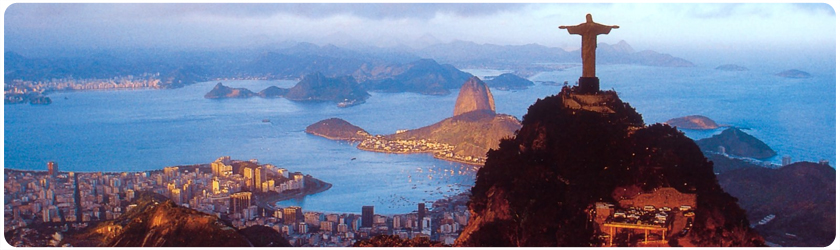
Brazil is the largest country in South America and the fifth largest country in the world after Russia, Canada, China, and the United States. It was a Portuguese colony from the landing of Pedro Alvares Cabral in 1500 until 1815 when it became a united kingdom with Portugal. In 1822 the country became independent as the Brazilian Empire, but has been a republic since 1889. Due to its origin, it is the only Portuguese-speaking country in South America.
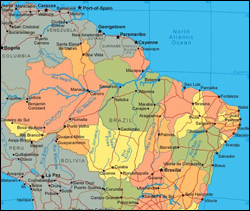
Brazil occupies a large area along the eastern coast of South America and includes much of the continent's interior, sharing land borders with Uruguay to the South; Argentina and Paraguay to the Southwest; Bolivia and Peru to the West; Colombia to the Northwest; and Venezuela, Suriname, Guyana and French Guiana to the North. It shares a border with every country in South America except for Ecuador and Chile. It also encompasses a number of oceanic archipelagos, such as Fernando de Noronha, Rocas Atoll, Saint Peter and Paul Rocks, and Trindade and Martim Vaz.
Its size, relief, climate, and natural resources make Brazil geographically diverse. It spans three time zones; from UTC-4 in the western states, to UTC-3 in the eastern states (and the official time of Brazil), and UTC-2 in the Atlantic islands. Brazilian topography is also diverse and includes includes hills, mountains, plains, highlands, and scrublands. Within this topographical diversity, one can find magnificent snow-capped mountains, rainbow waterfalls, and lush tropical rainforests.
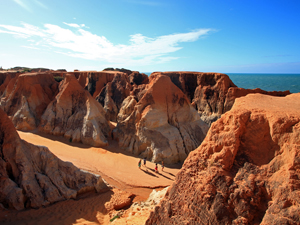
Brazil is also a country that's famous for its beaches, which embody almost
5,000 miles of pristine coastline with majestic white, gold, and rose colored
sands touched by crystal clear waters. The beaches of Brazil are among the
most beautiful in the world, with the country's northeast region of Ceara known
to hold the greatest appeal. Getting from one beach village to the next is
quick and easy by beach buggy, a preferred mode of local transportation and
among the unique samples of popular outdoor pursuits for visitors. Small, upscale
boutique hotels and beachfront resorts further cater to adventure seekers or
those opting to simply soak up the sun.
Fueled by foreign investment, a booming tourism industry and a growing domestic middle class, the northeast of Brazil has become a real estate hotspot and a popular destination for retirees from southern Brazil, Europe and recently North America. Brazil's continued emergence on the world stage is underscored by having Fortaleza named as a host city for the 2014 World Cup, and Rio de Janeiro as host for the 2016 Olympic Games.
Weather
The climate of Brazil comprises a wide range of weather conditions across a large area and varied topography. Most of the country is tropical but different climatic conditions produce environments ranging from equatorial rainforests to semiarid deserts and tropical savannas. An equatorial climate characterizes much of northern Brazil. There is no real dry season, but there are some variations in rain fall throughout the year. Temperatures average 77 F (25 C); Over central Brazil rainfall is more seasonal, characteristic of a savanna climate; The south enjoys temperate conditions, cool winters with occasional snowfall and average annual temperatures of 64 F (18 C). >> Brazil Weather
Economy
Characterized by large and well-developed agricultural, mining, manufacturing, and service sectors, Brazil has the world's ninth largest economy by nominal GDP, and the seventh largest by purchasing power parity. The Brazilian economy is characterized by moderately free markets and an inward-oriented economy, according to estimates from the International Monetary Fund and the World Bank.
During the mid-2000s, productivity gains coupled with high commodity prices contributed to a surge in Brazilian exports. Major export products include aircraft, electrical equipment, automobiles, ethanol, textiles, footwear, iron ore, steel, coffee, orange juice, soybeans and corned beef. The country has been expanding its presence in international financial and commodities markets.
It's no secret that Brazil's economy has been struggling in recent years while inflation is on the rise. Though its political turmoil has ended, the new president is faced with difficult challenges to bring the country back on track. But according to CNBC, "optimism in Latin America's largest economy has been brewing over the past three months since (President) Temer took over. Businesses and consumers are feeling more positive and [2017 GDP] estimates are now slightly positive."
The 2016 Olympics arrive in Brazil as the country begins to show signs
of its economy heading to positive territory, following a period of recession
and political uncertainty. Some economists drew consolation from data that showed a rise in investments
for the first time since 2013, perhaps signaling a floor to Brazil's most severe
economic crisis in decades.
Tourism
Tourism in Brazil is a growing sector and key to the economy of several regions
of the country. The country received 6.4 million foreign tourists in 2014,
the year of the Football World Cup, representing an increase of 10.6% over
2013. This increase amounted to a total of 600,000 more tourists, creating
a new record for international visitor arrivals.
More than 56 percent of arrivals flying into Brazil for the Rio 2016 Summer Olympic Games were visiting the country for the first time, according to a survey released this week by the Brazilian Tourism Board. Few other Olympic Games in recent memory created as much controversy as Rio 2016, but all of the airport, hotel, and transportation upgrades bode well for continued tourism development over the long-term.
Brazil offers for both domestic and international tourists a variety of options. Visitors can combine ecotourism with leisure and recreation, beach sports and adventure travel, as well as historic and cultural tourism. Among the most popular destinations are the Amazon Rainforest, beaches and dunes in the Northeast Region, the Pantanal in the Center-West Region, beaches at Rio de Janeiro and Santa Catarina, cultural and historic tourism in Minas Gerais, and business trips to Sao Paulo city.
The climate in northeastern Brazil is very sunny with a refreshing tropical
sea breeze. Compared to many other tropical destinations where the air can
have levels of humidity, the climate in the northeast of Brazil is dry and
more comfortable.
When Brazilians plan their holidays they don't have to look any further than their own border and they usually head to the northeast of Brazil (because of the climate). Once the economy improves along with the increased spending powers of the Brazilian population, this market should continue to accelerate and have a positive impact on coastal property prices.
Land of Opportunity
 Brazil is gaining interest from the international community for its low cost of living, a mild, temperate climate and affordable real estate. Brazil is gaining interest from the international community for its low cost of living, a mild, temperate climate and affordable real estate.
The Brazilian economy in 2016 is a far cry from that of seven years ago when Brazil won its bid to host the Games and oil prices were exponentially higher, according to information reported on the Skift website. At the time, oil-rich Brazil was positioned as one of the BRIC countries expected to emerge into something resembling a New World economy. With such a steep drop in resources to fund the Rio 2016 Olympics, it’s somewhat of a testament to the organizers who put together what for all accounts was a highly successful event under the circumstances.
The rental potential for Brazilian properties is exceptionally solid, particularly
for the domestic market. Brazil is a big country with a population of approximately
192 million. The northeast of Brazil is also a quickly growing holiday destination
for Brazilians and will likely become one of the leading tourist destinations
in the world, benefitting from both the World Cup effect in 2014 and Olympic Games in 2016. According to a survey by Economic Research Institute Foundation (FIPE), respondents ranked Rio’s hospitality highest, receiving 98.7 percent approval by international tourists and 92 percent by Brazilians. Following that, 94.6 percent of visitors approved of the airports, and 86.6 percent approved of the public transport.
What does this mean to visitors and potential investors?
Brazil property is the highest rated of all property in South America, and is increasingly gaining a reputation for also being the best international investment property for sale. Building and construction costs for Brazil property are low compared with much of the developed world, and real estate in Brazil offers unique investment opportunities for investors who want to benefit from the capital growth and rental returns that are possible.
“If you look at all of the facts, I don't think there is a better environment in all the world to invest than Brazil.” —Samuel Zell In 2004 Brazil targeted 2,000 miles of its costal area for development with the "Grow Northeast" program. The Fortaleza area alone, already the fastest growing area for tourism, will be receiving $4.5 billion. In preparation for the 13 million annual visitors that are expected, Fortaleza's International Airport will be expanded, upgrades will be made to the roads, telecommunications systems, public transportation, and health care facilities.
In the past, popular cities like Paris or Barcelona have benefitted considerably
from hosting the World Cup. This event help put Fortaleza and the nearby
northeastern cities on the world map. In certain areas of these host cities
real estate values more than doubled during the years preceding the event.
A city like Fortaleza, who's real estate ceiling has never been approached,
has certainly been benefitting.
Due to a lack of available housing for the Brazilians, some 20% of the population
lacks adequate housing. The current development of new mortgage laws will make
home ownership a more affordable option for much of the population, and help
accommodate foreign investor demand.
Selling Points
Brazil is one of the four largest developing economies in the world (the three others being China, India and Russia) with annual GDP growth of approximately 6%. According to Goldman Sachs, by 2050 Brazil will be the world's fifth largest economy.
The Brazilian currency, the reai, has dropped significantly versus the US dollar in recent years and has only recently shown signs of improvement since hitting a low point in the last quarter of 2015. With the Olympic Games ended and a new government pledging to focus on rebuilding the country's economy, this could signal better times ahead, particularly for foreign investors who can take advantage of the low currency valuation.
Compared to most other destinations, building costs are also low in Brazil. These conditions represent excellent opportunities for property investors as this translates to much lower purchase prices, and the benefit of favorable currency exchange rates. There are no restrictions imposed by the government on foreigners buying property in Brazil; property ownership is 100% freehold and secure.
The northeast of Brazil will benefit from massive investments along the coastline. In the next several years, billions will be invested in hotels, resorts and golf courses. Flight times to the region are a manageable six to nine hours from most European cities and more and more operators are extending service to Brazilian cities making it much more accessible to international travelers.
Visit Our Brazil Gallery & Properties
Please click an image below to make a selection.
Brazil Gallery
 |
Brazil Properties
 |
For questions about our services or to schedule an appointment with one of our representatives, please email us at: info@vinniesworld.com. You may also use our convenient Contact Us form.
|